Cold immersion often looks like a modern wellness trend, but the practice is far older than social media or ice tubs. For thousands of years, people have used cold water deliberately for recovery, ritual, and mental clarity.
In what is now London, Ontario, cold water has long been part of daily and ceremonial life. Rivers and lakes, including the Thames River, were used well before modern wellness language existed. Understanding that history helps separate useful practice from passing hype.
This article explains where cold immersion comes from, how it evolved, and why people still use it today.
Did Ancient Cultures Really Use Cold Water for Health?
Yes. Across many civilizations, cold water was used intentionally and not randomly or for shock value.
Greece and Rome
Public bathhouses commonly followed a sequence: warm, hot, then cold. Cold plunge pools were used briefly at the end of bathing to stimulate circulation and restore alertness. These practices later influenced European hydrotherapy and modern spa design.
Other Global Traditions
Rivers, lakes, and coastal waters were used for short, controlled exposure. While the explanations differed culturally, the structure was consistent:
- Brief cold exposure
- Followed by warming and rest
This pattern remains central to modern cold immersion protocols.
Indigenous Cold Water Practices Along the Thames River
Indigenous communities in the region had, and continue to have, a deep relationship with local waterways. Rivers and lakes were not simply physical resources; they were integral to ceremony, cleansing, and balance.
Cold-water immersion was often paired with heat exposure, such as in sweat lodges. The transition from heat to cold was used to support physical recovery and mark psychological or spiritual renewal.
These practices were experiential and contextual, developed through generations of observation rather than formal measurement.
How Cold Water Therapy Entered Western Medicine
In the 18th and 19th centuries, European and North American physicians promoted “water cures” and hydrotherapy. Cold baths were prescribed for fatigue, fever, low mood, and recovery after illness.
Ontario’s climate and access to cold lakes and rivers facilitated these practices.
While early explanations were limited, they laid the groundwork for later research into circulation, inflammation, and nervous system response.
What Modern Research Says About Cold Immersion
As sports science and physiology advanced, cold immersion became more structured and measurable.
Research has examined how short-term cold exposure affects:
- Blood vessel constriction and dilation
- Post-exercise muscle soreness
- Stress response and nervous system activation
- Perceived alertness and mood
Cold water immersion is now commonly used in athletic recovery and rehabilitation settings, with protocols focused on brief exposure, controlled temperatures, and adequate rewarming.
It is not a cure-all, but it can be a useful tool when used appropriately.
Cold Immersion in London, Ontario, Today
Cold immersion is now part of the local wellness landscape. People use it for different reasons, including:
- Post-training recovery
- Mental reset and stress management
- Building tolerance to discomfort in a controlled setting
Some choose natural bodies of water when conditions are safe. Others prefer indoor wellness spaces where temperature, duration, and safety are managed.
Why Cold Immersion Still Appeals
Across centuries, the reasons people return to cold water have stayed consistent: recovery.
Cold exposure may reduce perceived muscle soreness after intense activity, especially when used alongside rest and active recovery.
Circulation
Alternating cold and warm exposure causes blood vessels to constrict and dilate, supporting overall blood flow.
Stress and Mood
Cold exposure activates the nervous system, followed by a rebound calming effect for many people.
Mental Resilience
Learning to control breathing and remain calm during discomfort often transfers to everyday stress management.
Shared Experience
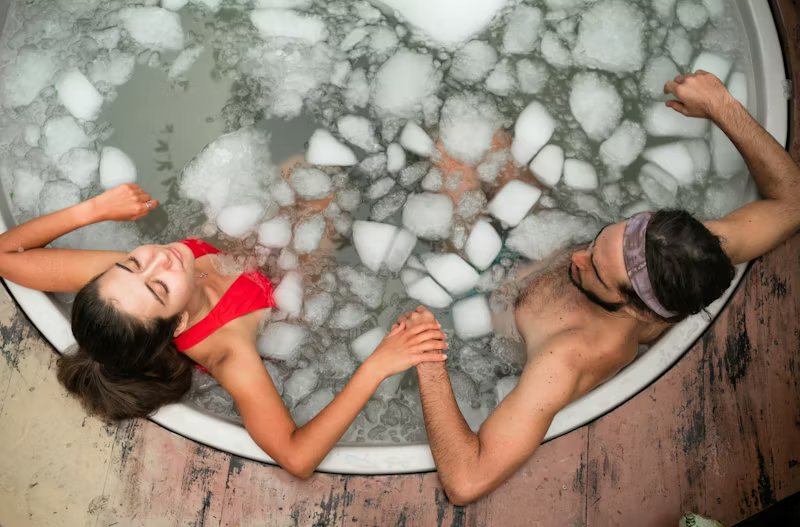
Group plunges, whether in nature or structured settings, create a sense of connection and accountability.
How to Try Cold Immersion Safely
If you’re new to cold immersion:
- Start with short exposures (seconds, not minutes)
- Focus on steady breathing rather than endurance
- Always rewarm gradually
- Avoid forcing longer or colder sessions
People with cardiovascular conditions, circulation issues, or other medical concerns should consult a healthcare professional before trying cold immersion.
Final Thoughts
From Indigenous traditions along the Thames River to European hydrotherapy and in modern recovery science, cold immersion has always served the same purpose: helping people regulate stress, recover physically, and reset mentally.
At Longevity Lounge, cold therapy is offered in a controlled, supportive environment that respects both modern safety standards and the long history behind the practice.
For those curious about adding cold immersion to their routine, guided sessions can be a practical way to explore its benefits without unnecessary risk.
Reference
- Tipton MJ et al. Cold water immersion: physiological responses and health effects. European Journal of Applied Physiology
https://pubmed.ncbi.nlm.nih.gov/28833689/ - Bleakley CM, Davison GW. Cold-water immersion and exercise-induced muscle damage. British Journal of Sports Medicine
https://pubmed.ncbi.nlm.nih.gov/19945970/ - Shevchuk NA. Adapted cold shower as a potential treatment for depression. Medical Hypotheses https://pubmed.ncbi.nlm.nih.gov/17993252/
- Kellmann M et al. Recovery and stress balance in athletes. Journal of Sports Sciences https://pubmed.ncbi.nlm.nih.gov/29345524/